
Japchae nutrition
Bonchon Japchae Calories and Nutrition
Bonchon Japchae has 887 calories in the 15.3 oz June 2026 source row. Review its complete macros and 2,322mg sodium, then see how the listed serving compares with Bibimbap, Tteokbokki, and Udon Noodle Soup.
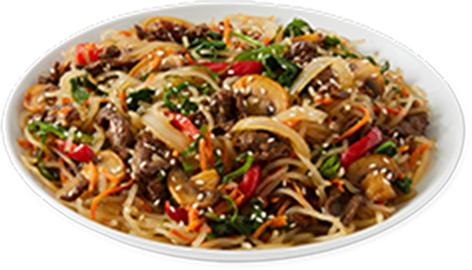 Japchae Calories
Guide overview
Bonchon Japchae has 887 calories in the 15.3 oz row
The official June 2026 source-backed row lists Bonchon Japchae at 887 calories for 15.3 oz. Use that weighted serving when matching the item in the calculator. The source does not define the row as one cup, half a plate, or a fixed number of portions, so a generic volume estimate should not replace the published weight.
The complete row reports 353 calories from fat, 39g total fat, 9g saturated fat, 1g trans fat, 43mg cholesterol, 2,322mg sodium, 115g carbohydrates, 5g dietary fiber, 25g sugar, and 22g protein. Reading those values together gives more useful context than treating 887 as the only number that matters.
How to use this page
Read the row, build the meal, then verify the source
The calculator is strongest when it is used as a comparison workflow. Browse the guide, open the relevant internal links, build exact rows in the calculator, and use official Bonchon pages for current restaurant-controlled details.
Each article in this guide set links back to related planning pages so visitors can move between calories, sodium, sides, protein, group orders, and source limits without losing the context of the full meal.
Complete nutrition row
Read the 887-calorie answer with the full panel
Japchae is a carbohydrate-forward noodle dish in this source row, but fat, sodium, fiber, sugar, and protein all help describe the complete published serving.
The 15.3 oz row contains 115g carbohydrates, including 5g fiber and 25g sugar, along with 22g protein. It also contains 39g total fat, 9g saturated fat, and 1g trans fat. The source lists 353 calories from fat and 43mg cholesterol.
Sodium is 2,322mg for the complete row. That figure should remain visible when comparing meal options because a lower-calorie item is not automatically a lower-sodium item. Use the calculator to keep calories, fat, carbohydrates, sugar, protein, and sodium in the same view.
Open the exact Japchae row
Search Japchae in the calculator and confirm the 15.3 oz serving before adding it to a meal total.
Review the source method
See how the June 2026 nutrition PDF and cleaned local data support the serving label and nutrient fields.
Serving and sharing
Use weight, not cups, when estimating part of the row
The source provides a 15.3 oz weight, so the most defensible partial-serving estimate starts with an evenly weighed share rather than the apparent volume of noodles on a plate.
An exact half of the published row is 7.65 oz and 443.5 calories, which can be rounded to about 444 calories. An exact quarter is 3.825 oz and about 222 calories. Those numbers are arithmetic divisions of the official row, not separate Bonchon serving entries.
Actual sharing may not be even. Half the visible noodles, half a takeout container, or one loosely filled cup may not contain half the complete dish. If a precise personal estimate matters, weigh the portion and compare that weight with the 15.3 oz source row instead of inventing a per-cup conversion.
Match serving and quantity first
The calculator guide explains why the published serving and the quantity actually selected should be checked before totaling a meal.
Browse nearby menu rows
Use the menu guide to find Japchae beside Bibimbap, Bulgogi, fried rice, and other source-backed dishes.
Menu comparison
Compare complete rows without assuming equal portion sizes
Japchae sits between several nearby dishes by calories, but their listed weights and full nutrition panels are different.
Base Bibimbap is listed at 785 calories for 21.5 oz, so Japchae has 102 more calories despite a row that is 6.2 oz lighter. Japchae also has 8g more fat, 419mg more sodium, 8g more carbohydrates, 7g less fiber, and 8g more protein than the base Bibimbap row. These differences describe two complete published dishes, not equal weights or interchangeable ingredients.
Tteokbokki is listed at 980 calories for 30.4 oz, which is 93 calories more than Japchae. Compared with Tteokbokki, Japchae has 21g more fat but 59g fewer carbohydrates, 458mg less sodium, and 10g less protein. Udon Noodle Soup is lower at 480 calories for 33.3 oz, yet its 4,300mg sodium is 1,978mg higher than Japchae. The comparison shows why calories, serving weight, sodium, and macros should be read together.
Compare calories with macros
Use the macro guide to compare protein, carbohydrates, fiber, sugar, and fat alongside calories.
Keep sodium in its own column
The sodium guide provides a source-first workflow for comparing dishes whose calorie and sodium rankings move differently.
Complete-order planning
Add only the separate extras that are actually ordered
The 887-calorie value belongs to the complete listed Japchae row. Separate menu items need separate rows when they are part of the planned meal.
If the order also includes chicken, rice, fries, a starter, dessert, a drink, or another separately listed item, add that item on its own in the calculator. Do not add a guessed ingredient value inside Japchae, and do not assume that a photo, promotion, or shared table setup changes what the nutrition row includes.
This article uses the June 2026 nutrition source as a planning reference. Restaurant recipes, portions, preparation, and availability can change after a source is published. Nutrition rows are not ingredient or allergen statements, so verify current official information and qualified guidance for allergies, medical diets, strict sodium limits, or other high-stakes decisions.
Check the current official source
Open the Bonchon nutrition page or current PDF before relying on dated values for a strict dietary need.
Understand source and allergen limits
Nutrition values do not confirm ingredients, substitutions, shared equipment, or cross-contact conditions.
FAQ
Quick answers about this guide
Short answers for visitors using the calculator as a planning reference.
How many calories are in Bonchon Japchae?
The June 2026 source-backed row lists Bonchon Japchae at 887 calories for 15.3 oz.
What is the serving size for the 887-calorie Japchae row?
The published serving is 15.3 oz. The source does not provide a per-cup value or state how many people should share the row.
How many calories are in half of the Bonchon Japchae row?
An exact half by weight would be 7.65 oz and 443.5 calories, or about 444 calories after rounding. A visual half or half a cup-based portion may not be an even half of the complete row.
Is Bonchon Japchae lower in calories than Bibimbap or Tteokbokki?
Japchae at 887 calories is 102 calories above the 785-calorie base Bibimbap row and 93 calories below the 980-calorie Tteokbokki row. Their listed weights differ, so compare them as complete published dishes rather than equal portions.
Do the 887 calories include every item in a Japchae meal?
The 887 calories apply to the complete listed Japchae row. Add separately ordered chicken, rice, fries, starters, desserts, drinks, or other menu items with their own source rows.
Source boundary
Independent guide with dated source references
This article is part of an independent Bonchon calorie calculator site. Nutrition values are planning references from the saved 2026-06 nutrition source and related menu snapshot. Verify current details through official Bonchon sources before ordering, especially for allergens, ingredients, sodium limits, medical diets, prices, and availability.